 National Rehab Helpline

ASun Star Consulting Inc
0.7 mi, East Rutherford199 Railroad Avenue, East Rutherford, NJ, 07073
Active
- Outpatient
- Medicaid
- Medicare
- Private insurance
City
No listed facilities are in Rutherford. The nearest listed facility is 0.7 miles from Rutherford. Compare the facilities near Rutherford below; distances are straight-line estimates.
This number connects to our central helpline, not directly to a listed facility.
When you first contact a drug rehab center in Rutherford, you can ask what happens during an intake appointment, what services are available, and how the program is structured. For example, a program like SERV Behavioral Health System Inc in Clifton may offer different levels of care. Call to confirm which services each program provides, whether there is a waiting list, and what you need to bring to your first visit.
Ask about the length of the program, what a typical day includes, and how the center coordinates with your primary care doctor or other healthcare providers.

Not every drug rehab center offers the same type of care, so it helps to understand the common categories before calling. At the most intensive end is inpatient rehab, where housing, meals, and treatment all happen in one place. A step down from that is a day treatment or partial hospitalization program, which is nearly as many hours of care but lets you return home each night.
Intensive outpatient care offers several sessions a week with more flexibility, and standard outpatient services offer the lightest schedule. Some people also begin with a period of supervised withdrawal management before moving into ongoing treatment. When you call a program, ask which of these levels they actually provide, since many facilities focus on just one or two.
Before committing to any rehab program, ask the same core questions of each one so you can compare answers. Start with the basics: what levels of care they provide, whether they have immediate openings, and what the admission process involves. Ask about treatment methods, whether medication is part of their approach, and how they handle co-occurring mental health conditions.
Get specifics on cost, insurance participation, and possible additional charges. Ask about visitation, phone access, and family involvement if those matter to you. It is also fair to ask what their aftercare and relapse support look like once the formal program ends.
To pay for care at a drug rehab center in New Jersey, people typically rely on private insurance, which may cover some or all treatment costs depending on the policy. Public health coverage, like state-administered plans, might be available for those who meet income and residency criteria; always check eligibility with the program office. Sliding-scale fees are often offered, reducing charges based on what you can afford, and self-pay is a straightforward option.
Because payment policies vary, you must speak with the admissions team at each center to learn exactly what they accept.
When choosing between drug rehab centers near you, start with fit rather than convenience. Ask whether each program has experience treating the substance and pattern of use you are dealing with, since some centers specialize. Compare the intensity of care available and whether you can move between levels if your needs change.
Look at what a normal day involves: how much is group therapy, how much is individual counseling, and what other services are included. Ask about family involvement, relapse support, and what the program does to help you continue care after discharge. Get a clear answer on cost, insurance participation, and any extra charges.
A program that explains these details openly and gives you time to decide is showing you how it treats people.
When you first contact a drug rehab center in Rutherford, you can ask what happens during an intake appointment, what services are available, and how the program is structured.

Emergencies connected to drug use need fast action, so treat them as emergencies first and treatment questions second. Call 911 for any suspected overdose, severe withdrawal reaction, or situation where someone may harm themselves or others. Stay with the person until help arrives if it is safe to do so.
For non-medical crises, the 988 Suicide and Crisis Lifeline provides free, confidential support by phone or text, day or night. Once the person is safe and stable, you can take time to compare rehab centers and plan ongoing care.
If you or someone else is in immediate danger, call 911 now.
199 Railroad Avenue, East Rutherford, NJ, 07073
Active
110 Main Avenue, Passaic, NJ, 07055
Active
777 Bloomfield Avenue, Clifton, NJ, 07012
Active
69 Jefferson Street, 1st Floor, Passaic, NJ, 07055
Active
121 Howe Avenue, Passaic, NJ, 07055
Active
595 County Avenue, Building 7, Secaucus, NJ, 07094
Active
595 County Avenue, Building 6, Secaucus, NJ, 07094
Active
595 County Avenue, Building 4-8, Secaucus, NJ, 07094
Active
595 County Avenue, Secaucus, NJ, 07094
Active
570 Belleville Avenue, Belleville, NJ, 07109
Active
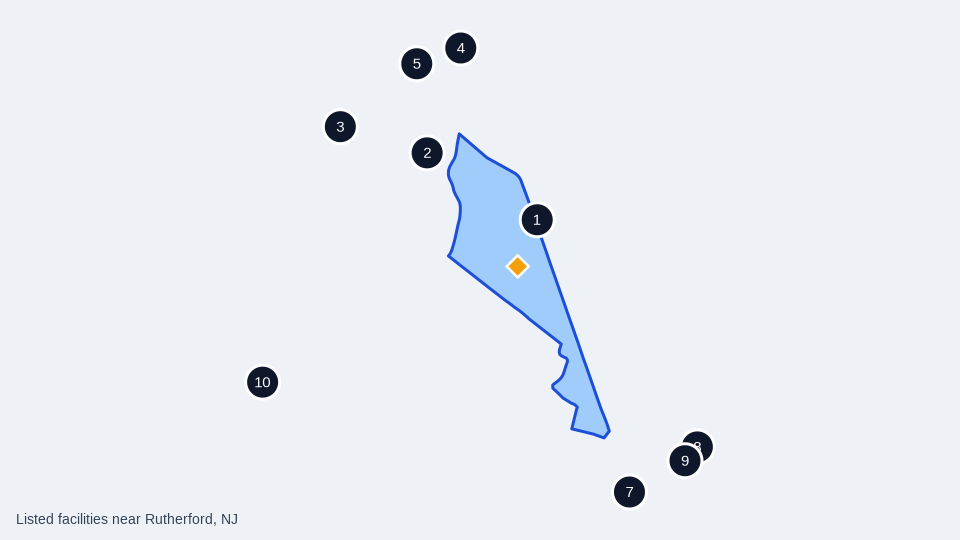
These lists use only what the 10 active facilities listed for Rutherford report to SAMHSA's FindTreatment.gov. No facility pays to be included or can ask to be moved. Reporting more options is not a measure of quality, outcomes or suitability for any person. A missing option means the facility did not report it to the source, not that it is not offered. Call the facility to confirm everything before relying on it.
How this list is made: each facility scores one point for each of these 5 levels of care (settings) it reports to SAMHSA's FindTreatment.gov (Residential (24-hour); Outpatient; Intensive outpatient; Partial hospitalization / day treatment; Hospital inpatient). A facility needs at least 3 to appear. Facilities are shown from the highest count to the lowest; facilities with the same count are in alphabetical order, which has no other meaning. Up to 10 are shown.
How this list is made: each facility scores one point for each of these 7 payment and cost-assistance options it reports to SAMHSA's FindTreatment.gov (Medicaid; Medicare; Private health insurance; Military insurance (TRICARE); Cash or self-payment; Sliding fee scale; Payment assistance). A facility needs at least 4 to appear. Facilities are shown from the highest count to the lowest; facilities with the same count are in alphabetical order, which has no other meaning. Up to 10 are shown.
How this list is made: each facility scores one point for each of these 4 medications used in treatment it reports to SAMHSA's FindTreatment.gov (Buprenorphine; Methadone; Naltrexone; Medication for alcohol use disorder). A facility needs at least 2 to appear. Facilities are shown from the highest count to the lowest; facilities with the same count are in alphabetical order, which has no other meaning. Up to 10 are shown.
How this list is made: each facility scores one point for each of these 12 age groups and client groups accepted it reports to SAMHSA's FindTreatment.gov (Adolescents; Young adults; Adults; Seniors; Pregnant or postpartum women; Adult women; Adult men; Veterans; Active duty military; Criminal justice clients; Clients who have experienced trauma; Co-occurring mental and substance use disorders). A facility needs at least 5 to appear. Facilities are shown from the highest count to the lowest; facilities with the same count are in alphabetical order, which has no other meaning. Up to 10 are shown.
Start by making a list of programs near you, including those in nearby towns like Clifton, Passaic, and Secaucus. Call each center to ask about its services, admission requirements, and what the program involves. Consider what type of support you are looking for, such as outpatient or residential care, and whether you need a program that can work with your schedule. Ask about the staff's qualifications and how the center develops a treatment plan for each person. It helps to call more than one program to compare your options before making a decision.
When you call a drug rehab center, ask what services it offers, how the intake process works, and what a typical day in the program looks like. Find out whether the center provides individual counseling, group therapy, or medication-assisted treatment. Ask about the length of the program, the cost, and what insurance plans are accepted. Also, ask how the program handles follow-up care or after you finish treatment. Write down your questions before you call so you do not forget anything.
Start with an honest picture of your situation: how often you use, whether you have tried to stop before, and what support you have at home. Then contact a few programs and ask for an assessment, which is how they match you to a level of care. You can also ask your primary care doctor for referrals. Comparing more than one program gives you a better sense of what fits.
Short programs may last about a month, longer residential stays often run two to three months, and outpatient treatment can continue for six months or more. The level of care matters too: inpatient programs are measured in weeks, while weekly counseling is measured in months. Progress is usually reviewed along the way rather than set in stone at admission. Ask programs how they handle extensions or step-downs if your needs change.
Cost depends on the level of care, the length of the program, and your insurance coverage, so the same program can cost two people very different amounts. The fastest way to a real number is to call with your insurance information in hand and ask for an estimate. Ask about charges beyond the base rate, such as medications, drug testing, or aftercare visits. Programs that will not give you a clear picture of costs before admission deserve extra scrutiny.
Last updated