 National Rehab Helpline

Boca Recovery Center
1.7 mi, Englewood255 Humphrey Street, Englewood, NJ, 07631
Active
- Residential
- Detox
- Medication-assisted treatment
- Private insurance
City
No listed facilities are in Leonia. The nearest listed facility is 1.7 miles from Leonia. Compare the facilities near Leonia below; distances are straight-line estimates.
This number connects to our central helpline, not directly to a listed facility.
When you contact a program, ask what happens during an intake appointment, what services are available, and how the program structures the first visit. It helps to know whether an assessment is done in person or remotely and what types of support are offered. Call to confirm current services and any requirements before you schedule a visit.

One practical way to compare drug rehab centers is by the levels of care each one offers, since not every facility provides every service. Detox is the entry point for some people: a medically supervised withdrawal period that typically lasts several days to a week. Inpatient or residential rehab follows for many, offering a live-in environment with daily therapy, group sessions, and structured routines.
Day treatment, often called partial hospitalization, delivers intensive programming during the day while you sleep at home. Intensive outpatient care reduces the time commitment further, usually three sessions per week for a couple of hours each. Traditional outpatient therapy is the most flexible option, fitting around jobs and family obligations.
Sober living homes sit at another point on the spectrum, providing drug-free housing with peer accountability rather than clinical treatment itself. Checking which of these a center actually runs, rather than just refers out for, tells you a lot about how complete its program is.
When you contact a drug rehab center, treat the call as a two-way interview. Useful questions fall into a few groups. About the program itself: What is your approach to treatment, and is it evidence-based?
How many clients are in a treatment group at once? What happens if I need a level of care you don't provide? About staff: Who leads the therapy sessions, and what licenses or degrees do they hold?
About cost and coverage: Do you take my insurance, and can you verify my benefits before I enroll? Are there scholarships, state funding, or sliding-scale options if I'm paying myself? About daily life: Can family visit or attend counseling, what is the policy on cell phones, and how do you handle medical needs or dietary restrictions?
About outcomes and follow-up: How do you support people after discharge, and is there an alumni network or continuing care group? Writing your questions down before the call keeps you from forgetting them in the moment.
Payment for addiction treatment at drug rehab centers throughout New Jersey can be handled through several common routes. Private insurance plans frequently include coverage for substance use disorder services, so checking your policy's benefits is a key first step. Publicly supported coverage, such as Medicaid or state-funded grants, may be accessible for qualifying residents.
Many centers also provide sliding-scale fees, adjusting costs according to a person's financial situation, and self-pay is an option. It is essential to contact each facility directly to confirm which payment options they accept.
Start with the kinds of care relevant to your needs.
Check each program’s listed services, location and contact details.
Contact a program to confirm availability, costs and the next step.
A few concrete criteria separate stronger programs from weaker ones. Does the center provide the full range you might need, from detox through aftercare, or will you have to transfer mid-treatment? Is it licensed by the state, and does its website or staff mention accreditation you can independently verify?
Does it base treatment on recognized methods rather than unproven alternatives, and does it offer medication-assisted treatment if opioids or alcohol are involved? Is the length of program fixed, or does it adjust to how you progress? Look also at who else is in the room: age-specific, gender-specific, or profession-specific groups can make therapy more relevant.
Cost transparency is a real criterion; a program that will not give you a clear picture of charges and insurance coverage before admission is a red flag. Check whether they address relapse openly and have a protocol for it, because setbacks are common and a good program plans for them. Speaking with a person who has completed the program, if the center can arrange it, can tell you things no brochure will.
When you contact a program, ask what happens during an intake appointment, what services are available, and how the program structures the first visit.

When safety is at stake, treatment options can wait; emergency care comes first. Call 911 for any suspected overdose, whether involving opioids, stimulants, or mixed substances, and for withdrawal symptoms that include hallucinations, severe shaking, or repeated vomiting. Give responders as much information as you can about what was taken, when, and how much, because this shapes the care they provide.
If you or someone you know is thinking about suicide, call or text 988 for the Suicide and Crisis Lifeline, where counselors respond at any hour. You can also text HOME to 741741 to reach the Crisis Text Line if speaking aloud feels difficult. Once the person is medically stable, hospital staff or a local helpline can connect you with drug rehab centers for ongoing treatment, and it is reasonable to ask them directly for that referral before leaving.
If you or someone else is in immediate danger, call 911 now.
255 Humphrey Street, Englewood, NJ, 07631
Active
93 West Palisade Avenue, Englewood, NJ, 07631
Active
97 Engle Street, Englewood, NJ, 07631
Active
581 Bergen Boulevard, Suite 2, Ridgefield, NJ, 07657
Active
596 Anderson Avenue, Suite 305, Cliffside Park, NJ, 07010
Active
1051 Riverside Drive, 1st Floor, New York, NY, 10032
Active
1051 Riverside Drive, 5th Floor, New York, NY, 10032
Active
103 Hudson Street, Hackensack, NJ, 07601
Active
1 Bergen County Plaza, 2nd Floor, Hackensack, NJ, 07601
Active
4580 Broadway, New York, NY, 10040
Active
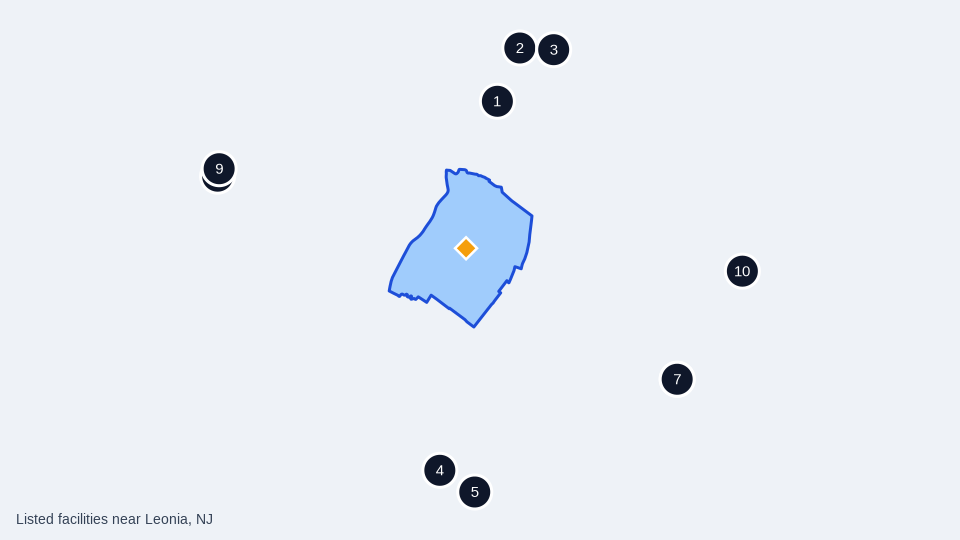
These lists use only what the 10 active facilities listed for Leonia report to SAMHSA's FindTreatment.gov. No facility pays to be included or can ask to be moved. Reporting more options is not a measure of quality, outcomes or suitability for any person. A missing option means the facility did not report it to the source, not that it is not offered. Call the facility to confirm everything before relying on it.
How this list is made: each facility scores one point for each of these 5 levels of care (settings) it reports to SAMHSA's FindTreatment.gov (Residential (24-hour); Outpatient; Intensive outpatient; Partial hospitalization / day treatment; Hospital inpatient). A facility needs at least 3 to appear. Facilities are shown from the highest count to the lowest; facilities with the same count are in alphabetical order, which has no other meaning. Up to 10 are shown.
How this list is made: each facility scores one point for each of these 7 payment and cost-assistance options it reports to SAMHSA's FindTreatment.gov (Medicaid; Medicare; Private health insurance; Military insurance (TRICARE); Cash or self-payment; Sliding fee scale; Payment assistance). A facility needs at least 4 to appear. Facilities are shown from the highest count to the lowest; facilities with the same count are in alphabetical order, which has no other meaning. Up to 10 are shown.
How this list is made: each facility scores one point for each of these 4 medications used in treatment it reports to SAMHSA's FindTreatment.gov (Buprenorphine; Methadone; Naltrexone; Medication for alcohol use disorder). A facility needs at least 2 to appear. Facilities are shown from the highest count to the lowest; facilities with the same count are in alphabetical order, which has no other meaning. Up to 10 are shown.
How this list is made: each facility scores one point for each of these 12 age groups and client groups accepted it reports to SAMHSA's FindTreatment.gov (Adolescents; Young adults; Adults; Seniors; Pregnant or postpartum women; Adult women; Adult men; Veterans; Active duty military; Criminal justice clients; Clients who have experienced trauma; Co-occurring mental and substance use disorders). A facility needs at least 5 to appear. Facilities are shown from the highest count to the lowest; facilities with the same count are in alphabetical order, which has no other meaning. Up to 10 are shown.
Ask what services they offer, how the intake process works, what types of counseling or therapy are available, and whether they provide outpatient or residential care. Also ask about hours, location, and any costs or insurance they accept.
Some programs accept self-referrals while others may require a referral from a doctor or agency. Call the center directly to ask about their admission process.
Yes, in most cases, though every facility has its own medication policy. Bring your prescriptions in their original bottles and tell the intake staff about everything you take, including psychiatric medications. The medical team will review your medications during assessment and continue what is appropriate. Some facilities restrict certain drugs for safety reasons, so disclose everything upfront to avoid problems after admission.
Most rehab centers welcome family involvement, and many build it directly into the program. Common options include family therapy sessions, educational groups where loved ones learn about addiction and recovery, scheduled visitation, and updates on your progress within privacy limits. Some centers hold weekend family programs or workshops. The extent of involvement varies by facility, so ask about their specific family services when you call.
Yes, treatment for substance use is protected by stronger privacy laws than general medical care. Federal rules under 42 CFR Part 2 specifically restrict drug and alcohol treatment records, and facilities cannot confirm to anyone, including employers or family, that you are a patient without your written consent. The usual medical privacy protections under HIPAA also apply. Staff will explain the limits, such as situations involving danger to yourself or others, when you enroll.
Last updated