 National Rehab Helpline
383 Stan Evans Drive, Jefferson, GA, 30549
Active
- Residential
- Detox
- Medication-assisted treatment
- Medicaid
City
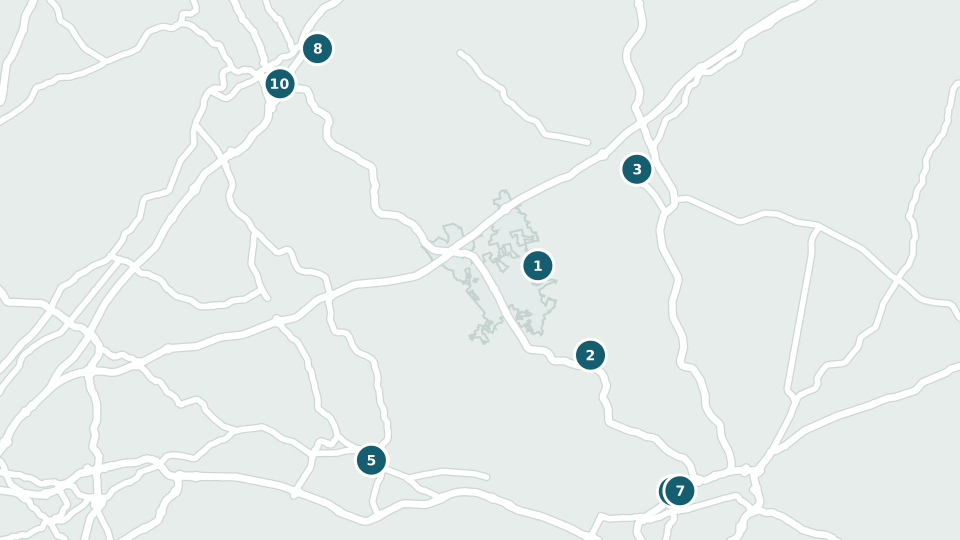
10 options near Jefferson, GA, nearest first. Compare services and locations, then call to check availability.
Call (833) 659-6966Ask about your optionsThis number connects to our central helpline, not directly to a listed facility.
Check which services are available for your needs.
Confirm payment options and any waiting time directly.
Ask what information the program needs from you.
Reaching out for help with substance use takes real courage, and knowing what to ask can make the first call feel less overwhelming. When you contact a treatment program in the Jefferson area, it helps to have a few questions ready so you can find the right fit for your situation.
You might start by asking what happens during a first appointment. Many programs begin with an assessment, where a staff member asks about your substance use history, your health, and what you hope to get out of treatment. This helps them recommend a level of care that fits your needs. You can also ask whether appointments are held in person, by phone, or through video visits, and what hours the program keeps.
Other useful questions include how long treatment typically lasts, what kinds of counseling are offered, and whether family members can take part in your care. If you work or care for others, ask about scheduling flexibility. If cost is a concern, ask upfront about payment options and whether the program accepts your insurance, so there are no surprises later.
Trust matters in this process. Pay attention to how the staff treat you when you call or visit. A good program will answer your questions patiently, explain things clearly, and never pressure you into a decision. If one option does not feel right, you are free to keep looking until you find a place where you feel respected and comfortable. Help is available, and taking the first step today can open the door to recovery.
Call (833) 659-6966
One practical way to compare drug rehab centers is by the levels of care each one offers, since not every facility provides every service. Detox is the entry point for some people: a medically supervised withdrawal period that typically lasts several days to a week. Inpatient or residential rehab follows for many, offering a live-in environment with daily therapy, group sessions, and structured routines.
Day treatment, often called partial hospitalization, delivers intensive programming during the day while you sleep at home. Intensive outpatient care reduces the time commitment further, usually three sessions per week for a couple of hours each. Traditional outpatient therapy is the most flexible option, fitting around jobs and family obligations.
Sober living homes sit at another point on the spectrum, providing drug-free housing with peer accountability rather than clinical treatment itself. Checking which of these a center actually runs, rather than just refers out for, tells you a lot about how complete its program is.
Call (833) 659-6966Check which services each program reports offering.
Consider travel distance and whether care is in person or remote.
Ask the program directly about payment and coverage.
Confirm how to contact the program and what to expect.
When you contact a drug rehab center, treat the call as a two-way interview. Useful questions fall into a few groups. About the program itself: What is your approach to treatment, and is it evidence-based?
How many clients are in a treatment group at once? What happens if I need a level of care you don't provide? About staff: Who leads the therapy sessions, and what licenses or degrees do they hold?
About cost and coverage: Do you take my insurance, and can you verify my benefits before I enroll? Are there scholarships, state funding, or sliding-scale options if I'm paying myself? About daily life: Can family visit or attend counseling, what is the policy on cell phones, and how do you handle medical needs or dietary restrictions?
About outcomes and follow-up: How do you support people after discharge, and is there an alumni network or continuing care group? Writing your questions down before the call keeps you from forgetting them in the moment.
When exploring drug rehab centers throughout Georgia, prospective patients and their families will find that paying for treatment usually comes down to a few well-established approaches. A large share of people use private insurance to help offset the expense of detoxification, residential care, therapy sessions, and aftercare. Public programs may play a role as well; residents who meet income and other requirements might access coverage through options like Medicaid, but details vary case by case.
Sliding-scale fees are another practical route, allowing facilities to charge based on what someone can reasonably afford. Paying directly out of pocket is also possible for individuals who want privacy or don't have coverage. Whichever path seems best, it's wise to verify coverage details and confirm payment arrangements with any facility before starting a program, as eligibility and accepted payments differ from one provider to another.
A few concrete criteria separate stronger programs from weaker ones. Does the center provide the full range you might need, from detox through aftercare, or will you have to transfer mid-treatment? Is it licensed by the state, and does its website or staff mention accreditation you can independently verify?
Does it base treatment on recognized methods rather than unproven alternatives, and does it offer medication-assisted treatment if opioids or alcohol are involved? Is the length of program fixed, or does it adjust to how you progress? Look also at who else is in the room: age-specific, gender-specific, or profession-specific groups can make therapy more relevant.
Cost transparency is a real criterion; a program that will not give you a clear picture of charges and insurance coverage before admission is a red flag. Check whether they address relapse openly and have a protocol for it, because setbacks are common and a good program plans for them. Speaking with a person who has completed the program, if the center can arrange it, can tell you things no brochure will.
Reaching out for help with substance use takes real courage, and knowing what to ask can make the first call feel less overwhelming.

When safety is at stake, treatment options can wait; emergency care comes first. Call 911 for any suspected overdose, whether involving opioids, stimulants, or mixed substances, and for withdrawal symptoms that include hallucinations, severe shaking, or repeated vomiting. Give responders as much information as you can about what was taken, when, and how much, because this shapes the care they provide.
If you or someone you know is thinking about suicide, call or text 988 for the Suicide and Crisis Lifeline, where counselors respond at any hour. You can also text HOME to 741741 to reach the Crisis Text Line if speaking aloud feels difficult. Once the person is medically stable, hospital staff or a local helpline can connect you with drug rehab centers for ongoing treatment, and it is reasonable to ask them directly for that referral before leaving.
If you or someone else is in immediate danger, call 911 now.
Call (833) 659-6966383 Stan Evans Drive, Jefferson, GA, 30549
Active
655 Potters House Road, Jefferson, GA, 30549
Active
734 Hospital Road, Commerce, GA, 30529
Active
112 Lanthier Street, Winder, GA, 30680
Active
98 Lanthier Street, Winder, GA, 30680
Active
240 Mitchell Bridge Road, Athens, GA, 30606
Active
1435 Oglethorpe Avenue, Athens, GA, 30606
Active
2467 Old Cornelia Highway, Gainesville, GA, 30507
Active
915 Interstate Ridge Drive, Suite G, Gainesville, GA, 30501
Active
915 Interstate Ridge Drive, Suite C, Gainesville, GA, 30501
Active
Ask what happens at a first appointment, what levels of care they offer, how long treatment usually lasts, what counseling options exist, and how payment or insurance works. You can also ask whether family can be involved and whether visits happen in person or virtually. A quality program will welcome these questions and answer them clearly without pressuring you.
No. You can contact more than one program, compare what each offers, and take time to choose the option that fits your needs and schedule. If a program pressures you to decide on the spot or makes you uncomfortable, it is reasonable to keep looking until you find care where you feel respected and understood.
Yes, in most cases, though every facility has its own medication policy. Bring your prescriptions in their original bottles and tell the intake staff about everything you take, including psychiatric medications. The medical team will review your medications during assessment and continue what is appropriate. Some facilities restrict certain drugs for safety reasons, so disclose everything upfront to avoid problems after admission.
Most rehab centers welcome family involvement, and many build it directly into the program. Common options include family therapy sessions, educational groups where loved ones learn about addiction and recovery, scheduled visitation, and updates on your progress within privacy limits. Some centers hold weekend family programs or workshops. The extent of involvement varies by facility, so ask about their specific family services when you call.
Yes, treatment for substance use is protected by stronger privacy laws than general medical care. Federal rules under 42 CFR Part 2 specifically restrict drug and alcohol treatment records, and facilities cannot confirm to anyone, including employers or family, that you are a patient without your written consent. The usual medical privacy protections under HIPAA also apply. Staff will explain the limits, such as situations involving danger to yourself or others, when you enroll.